SEDD Design Pre Approval
 Sharjah Municipality Parking Reservation Approval
 RTA Pre Approval
 Government of Ajman
 DESIGN & APPROVAL
 OUTDOOR & INDOOR BRANDING
 SIGNAGES
 VEHICLE BRANDING
 FLAGS & BANNERS
 OTHER SERVICES
Key takeaways
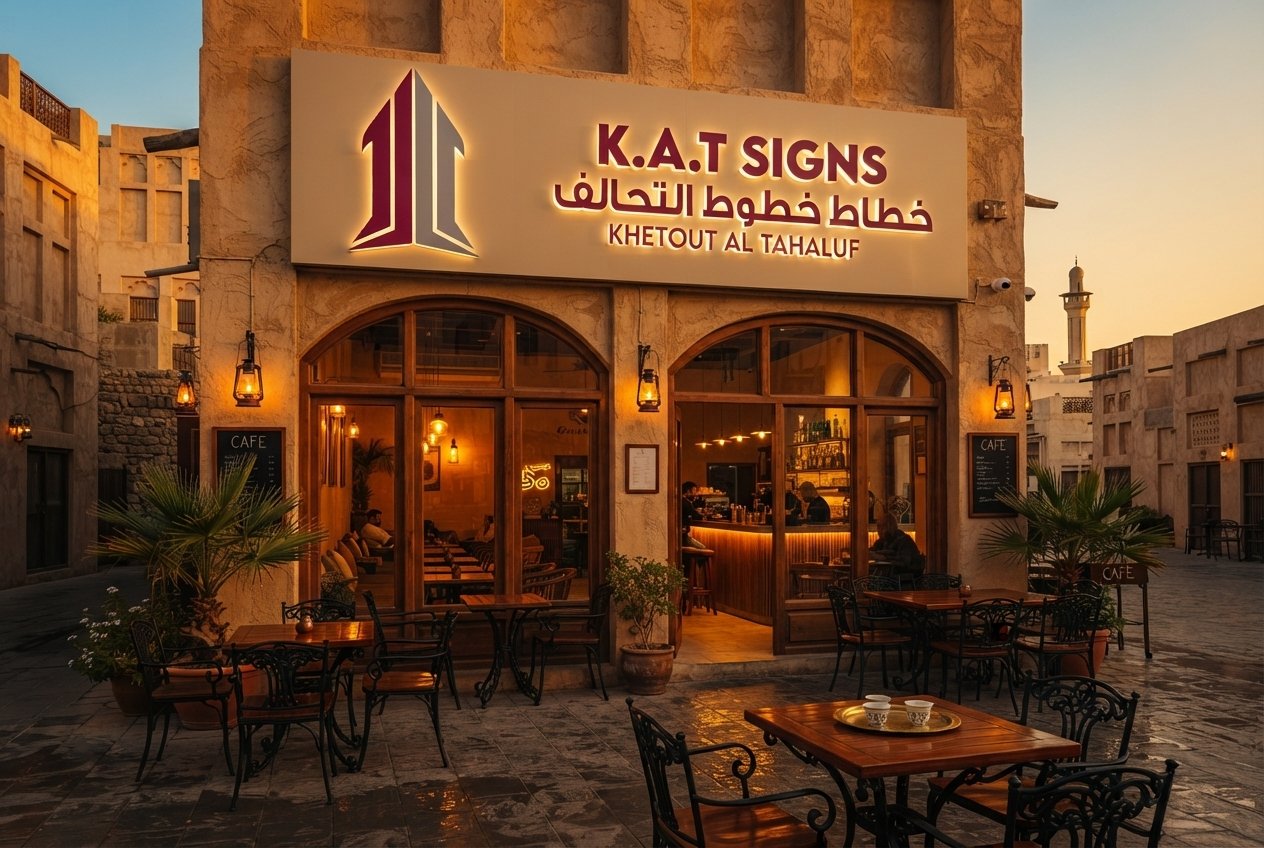
- A strong food venue uses a layered signage set: a main sign, a blade/projecting sign, menu boards and window graphics.
- Illuminated 3D channel letters (about AED 1,500–8,000) give evening-trade venues the night presence they need.
- Every exterior sign must match the DED trade licence, carry Arabic no smaller than the English, and clear municipality approval.
- Malls add their own fit-out and brand rules on top, so plan for two approvals.
Restaurants and cafés live and die by footfall after dark, so their signage has to do more than name the place — it has to pull people in from the road, from the pavement and from across a mall atrium, at exactly the hour the sun has gone down.
What signage does a restaurant or café need?
A food venue needs a layered signage set, not a single sign, because it has to catch attention at several distances at once. The core kit is a main illuminated shopfront sign for road and frontage visibility, a projecting “blade” sign so people walking along the pavement or mall corridor see you side-on, menu or feature boards near the entrance, and window graphics on the glass. Each element catches a different sightline, and together they turn a passing glance into a table.
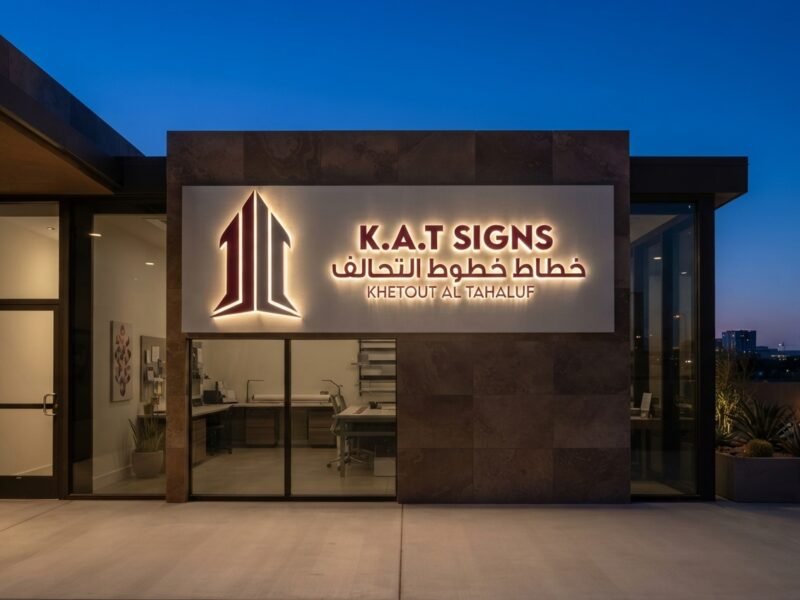
For evening-trade venues the main sign almost always wants to be illuminated — a café that closes at midnight is invisible for its busiest hours without light. That is why 3D illuminated channel letters, at roughly AED 1,500 to 8,000 for a standard shopfront, are the default for hospitality.
Why do blade signs matter for food venues?
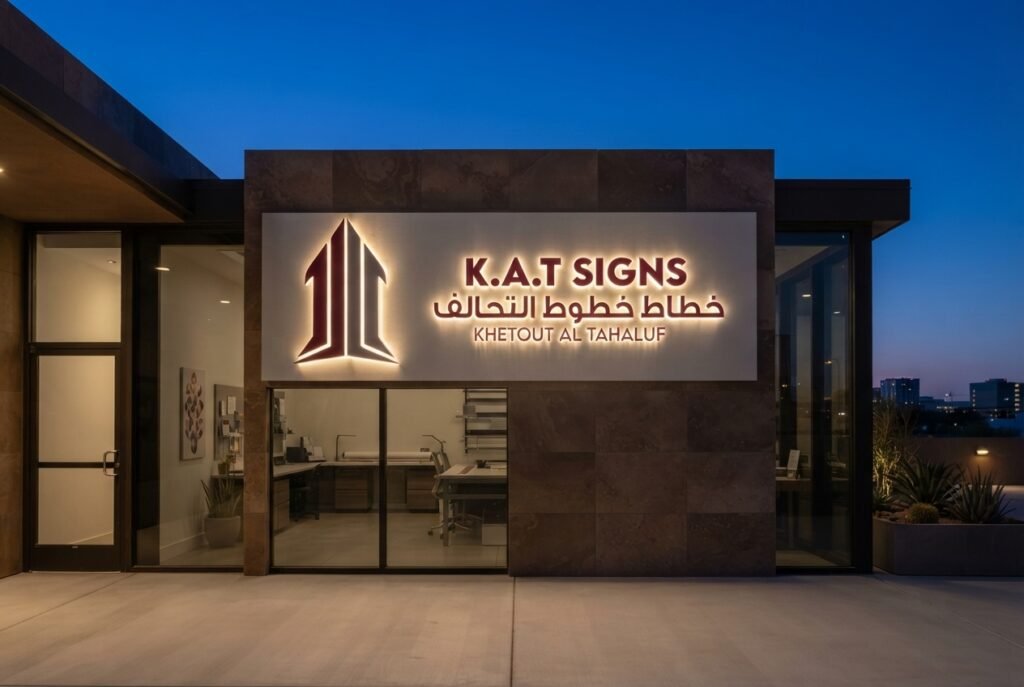
Blade signs win the pedestrian. A projecting blade sign sits perpendicular to your facade, so people walking toward you — along a pavement, through a mall corridor, down a restaurant strip — read it side-on long before they would ever notice a flat sign facing the road. In dense F&B clusters where a dozen venues sit shoulder to shoulder, the blade sign is often what actually gets you seen. Keep it simple: your name or logo, lit if the corridor is dim.
Hospitality tip: Warm-white LED illumination reads as inviting and appetising for cafés and restaurants; harsh cool-white can feel clinical. Match the light temperature to the mood of the food.
What signage elements should a venue layer?
- Main sign — illuminated 3D channel letters across the facade for road and frontage visibility.
- Blade / projecting sign — catches pedestrians and mall-corridor traffic side-on.
- Menu & feature boards — near the door, easy to update for specials and seasons.
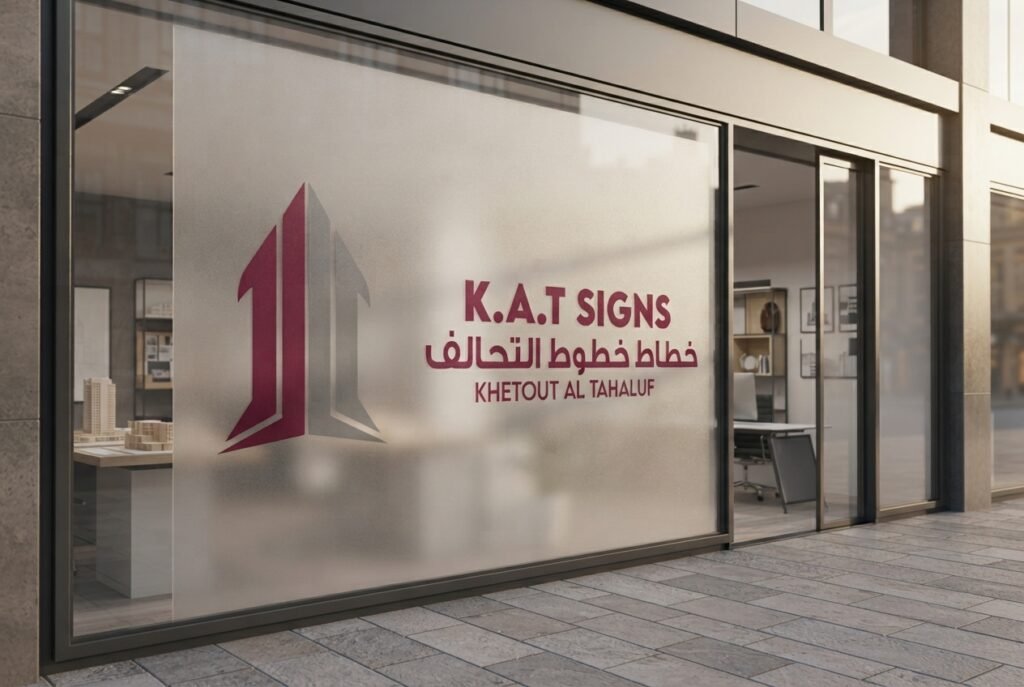
- Window graphics — hours, offers and brand illustration on the glass, changeable per campaign.
- Interior & wayfinding — brand walls, restroom and directional signs that complete the experience.
What does a café signage set cost?
Budget by element, because a venue buys a set, not a single board. The rough 2026 ranges look like this:
| Element | Typical 2026 range (AED) | Role |
|---|---|---|
| Main illuminated 3D channel letters | 1,500 – 8,000 | Primary road/frontage visibility |
| Full illuminated 3D LED shopfront | 8,000 – 15,000 | Whole-facade brand statement |
| Blade / projecting sign | 1,500 – 5,000 | Pedestrian and corridor traffic |
| Window graphics & frosting | From ~1,500 | Hours, offers, privacy, branding |
| Overall shop signboard | 1,500 – 15,000 | Depends on size, materials, illumination |
What compliance rules apply to F&B signage?
The same shop-sign rules apply to every element on the exterior. Each sign must match the DED trade licence exactly, carry Arabic text no smaller than the English, and clear municipality approval before it is fabricated and installed. If the venue sits in a mall or food court, the mall’s fit-out and brand guidelines apply on top, and those often dictate the sign zone, depth and illumination. In short, a restaurant plans for two approvals — the authority and the mall — and builds nothing until both are cleared.
What indoor and wayfinding signage do venues need?
The customer’s experience does not stop at the door, and neither should the signage. Inside, a food venue typically wants a branded feature wall for the space and for customers’ photos, clear directional and restroom signs, and often a digital or printed menu board at the counter for quick-service formats. Getting the interior signage to match the exterior — same typeface, same colours, same finish quality — is what makes a venue feel considered rather than thrown together. For larger restaurants and food courts, wayfinding that guides people to seating, ordering and collection points keeps the flow smooth at peak times and quietly reinforces the brand at every turn.
How do delivery and takeaway change the sign set?
Delivery-heavy venues have an extra audience: riders and drivers who need to find and identify the unit fast. A clearly lit main sign and a legible blade sign help couriers spot you from the road or across a car park, and a small, well-placed collection or pickup sign at the counter speeds up handovers during a rush. Ghost kitchens and delivery-only brands still benefit from clean unit signage and branded packaging graphics even without a dine-in frontage, because every touchpoint the customer photographs or the rider sees is a branding opportunity. The rule is the same as the storefront: make the name easy to find, day and night.
How long does a full signage set take to roll out?
Budget the timeline around approvals, not just fabrication. Because every exterior element needs municipality approval — and mall units need fit-out sign-off too — the critical path is usually getting the drawings approved, which is why a venue should lock its licensed name and artwork early and submit while other fit-out work continues. Fabrication of channel letters, blade signs and menu boards can run in parallel once the designs are set, and installation is scheduled for after the shopfit so nothing is damaged. Start the signage conversation at the same time as the fit-out, not at the end, and the signs are lit and ready for opening day rather than weeks behind it.
How to plan a venue’s signage rollout
Sequence the work so nothing gets remade:
- Confirm the exact licensed trade name and set bilingual, brand-accurate artwork.
- Design the full set together — main, blade, menu and window — so they read as one brand.
- Clear municipality and mall approvals in parallel with fabrication scheduling.
- Fabricate in UAE-grade materials — marine-grade aluminium, UV-stabilised acrylic, IP65 drivers.
- Install and light-test after dark, when your customers actually see it.
People do not choose a restaurant they cannot see. After sunset, light is not decoration — it is the invitation.
Bring the whole storefront together
The main sign is usually where to start — see 3D channel letter signs for build and cost, and window graphics & frosting for the glass. Deciding whether to light it all is covered in illuminated vs non-illuminated shop signs, and before anything is built, work through shop signboard approval in Dubai.
K.A.T SIGNS designs, permits, fabricates and installs complete restaurant and café signage sets in-house across Sharjah, Dubai, Ajman and Abu Dhabi — bilingual, DED-matched and mall-compliant. See our outdoor & indoor branding service and the full storefront first impression guide.